The Potsdam Conference
Considered by some as the final meeting of the ‘Big Three,’ the Potsdam Conference occurred between 17 July and 2 August 1945. The meetings were distinctly different from previous wartime meetings, such as Teheran or Yalta, not only because the war in Europe was over, but because the death of US President Roosevelt just months before meant his successor, President Truman took his place. Later changes during the conference also included the replacement of Churchill with new Labour PM Clement Attlee.[1]

While the war in Europe was over, there was still war raging between British and US, and Japanese troops. This meant that, with the absence of a common enemy, the Potsdam conference attendees had a difficult time in reaching an agreement concerning the post-war political restructuring of Europe.[2] There were, however, some agreements made at Potsdam, and thus the Potsdam Agreement was written.
The Potsdam Agreement was made between the three major Allies of the Second World War, the United Kingdom, the United States, and the Soviet Union, on 1 August 1945. It demanded that Germany would be demilitarised, disarmed, and any industry being used for military purposes to be dismantled. Furthermore, Germany was to be occupied by an Allied Control Commission, made up of Americans, British, French and Soviets.[3] With regards to any Nazi influence, all was to be removed, with the country’s educational and judicial system being purged and restructured, Nazi racial laws and legislations repealed and war criminals to be tried and punished with maximum sentences.[4]
It was surprisingly not German’s fate that caused the most debate during the Conference, however, but rather that of Poland. Between the revision of its borders and the expulsion of millions of ethnic Germans from Eastern Europe, questions around Poland had occurred at both the Teheran and Yalta conference, but it was at Potsdam that the possibility of change became a reality for the first time.[5]
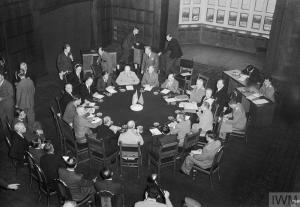
It was agreed that in exchange for territory lost to the Soviet Union, Poland would be compensated in the east by large areas of Germany, however the real problem came because the Polish, along with the Czechs and Hungarians, had begun to oust German minorities.[6] Both the American and British delegates were worried that a mass influx of Germans into their respective Control zones could cause massive destabilisation. It was therefore decided that Poland, Czechoslovakia and Hungary must to temporarily suspend the expulsions of ethnic Germans on the promise that they could resume the process in an “orderly and humane manner” once a more secure situation had been created.[7]
Lastly, the subsequent Potsdam Declaration, issued on 26 July 1945, threatened massive aerial and naval attack, along with land invasion, by the US, UK, and China if the Japanese failed to agree to unconditional surrender. This “prompt and utter destruction” was first mentioned at the Potsdam Conference by President Truman, when he mentioned to Stalin about the new US weapon that held “special destructive force.” [8] It was, however, never specifically mentioned that this was in fact the infamous atomic bomb.[9] The subsequent failure of Japan to surrender lead to months of fighting, culminating in the dropping of the atomic bombs on Hiroshima on 6 August and Nagasaki on 9 August 1945. This led to the official ending of the Second World War five days later, on 14 August 1945.
The Paris Peace Conference
It was during the Potsdam Conference that an agreement was also reached regarding the ending of “the present anomalous position” of Germany’s wartime allies. Thus, the Paris Peace Treaties, signed on 10 February 1947, were the outcome of the Paris Peace Conference that lasted from 29 July until 15 October 1946. Once again attended by the victorious Allied powers, the aim of the conference was to negotiate the details of peace treaties with Italy, Romania, Hungary, Bulgaria and Finland.
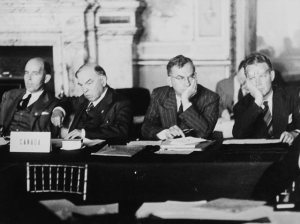
While the conclusion of the negotiations at the Paris Peace Conference determined that the defeated powers could resume their responsibilities as sovereign states and thus qualify for membership in the United Nations, a number of sanctions were also imposed. The Treaties stated that war reparations must be paid, that a commitment must be made to minority rights, that territorial adjustments must be made, and that accused war criminals must be handed over to the Allies for trial.
[1] History, “Potsdam Conference,” last accessed 15 January 2023, https://www.history.com/topics/world-war-ii/potsdam-conference
[2] Imperial War Museum (IWM), “How the Potsdam Conference shaped the future of post-war Europe,” last accessed 15 January 2023, https://www.iwm.org.uk/history/how-the-potsdam-conference-shaped-the-future-of-post-war-europe
[3] IWM, “How the Potsdam Conference shaped the future of post-war Europe”
[4] IWM, “How the Potsdam Conference shaped the future of post-war Europe”
[5] IWM, “How the Potsdam Conference shaped the future of post-war Europe”
[6] IWM, “How the Potsdam Conference shaped the future of post-war Europe”
[7] IWM, “How the Potsdam Conference shaped the future of post-war Europe”
[8] IWM, “How the Potsdam Conference shaped the future of post-war Europe”
[9] IWM, “How the Potsdam Conference shaped the future of post-war Europe”
[Image 1] IWM, “Winston Churchill During the Second World War,” July 23, 1945, BU 9197, https://www.iwm.org.uk/collections/item/object/205195912
[Image 2] IWM, “The Potsdam Conference, July 1945,” July 17, 1945, BU 8985, https://www.iwm.org.uk/collections/item/object/205193813
[Image 3] WikiCommons, “King Paris Peace 1946,” August 1946, https://commons.wikimedia.org/wiki/File:KingParisPeace1946.jpg
 It’s all in the Past...
One thought on “T is for… The Treaties of the Second World War”