On 8 May 1945, with the surrender of the German forces, World War II came to an end in Europe. However, this was not the end. It took until 14 August of the same year before the Japanese forces surrendered to the US Army and thus the Second World War officially ended. This day was especially important, marking the day that the exhausting and brutal war that had been raging for six years was finally over. This blog will explore both the end of the war in Europe, and the subsequent signing of the surrender documentation four months later by the Japanese.
Victory in Europe
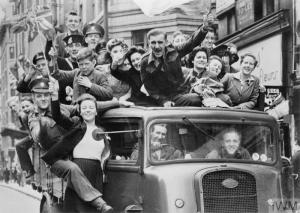
Following the suicide of Hitler, and the subsequent succession of Grand Admiral Karl Donitz, a German delegation arrived in British Field Marshal Montgomery’s headquarters in Luneburg Heath, Germany on 4 May 1945.[1] The unconditional surrender was given of the German forces in the Netherlands, northwest Germany, and Denmark. A few days later, on 7 May, the surrender of all German forces was accepted by Supreme Allied Commander General Eisenhower at his headquarters in Reims, France.
Also known as VE Day, Victory in Europe Day was a momentous occasion, one which marked the end of nearly six years of war that had cost millions of lives. People across Europe celebrated the news that Germany had surrendered with street parties, parades, and thanksgiving services. A national holiday was declared in Britain, for example, with commemorative mugs quickly being produced, restaurants offering special ‘victory’ menus and people being able to buy red, white and blue bunting without the need of ration coupons.[2]
Victory over Japan
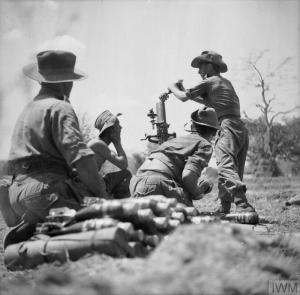
However, VE Day did not mark the end of the war entirely. For those still serving as part of the Allied forces, VE Day meant little to them, still faced with the brutality of war in the Far East and Pacific. In Australia, for example, while there were street parties to celebrate the ending of war in Europe, the mood was bittersweet, with many Australians still service overseas.[3]
The final months of war in the Pacific saw heavy casualties. Allied servicemen who had fought in Europe were redeployed to the Far East and the Pacific where fighting would continue for another three months. The Potsdam Declaration, issued by the Allied leaders on 26 July 1945 called on the Japanese forces to surrender, however the Japanese government in Tokyo refused, leading to the dropping of the infamous atomic bombs on Hiroshima (6 August) and Nagasaki (9 August).[4]
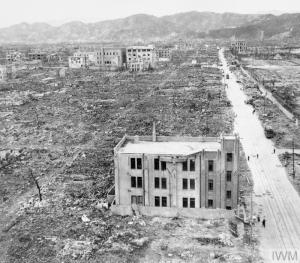
Following the dropping of the atomic bombs there was huge expectation that the war would finally be over. Incorrect news that the Japanese government had informed the Allies they were willing to accept the terms of unconditional surrender were leaked, prompting premature celebrating. However, negotiations within the Japanese government had stalled, with some unwilling to accept the Allied conditions of surrender.[5]
Despite this, by 14 August, the US President, Harry Truman, announced the final cessation of hostilities. Once again, celebrations occurred across the globe despite the formal signing of surrender not occurring until 2 September 1945, onboard the USS Missouri anchored in Tokyo Bay.[6] Thereafter known as Victory over Japan Day (V-J Day), for many V-J Day was especially important, not only because it marked the end of the gruesome war, but for many it was at this moment the reality that their loved ones would not be returning home truly sunk in.
The feelings across the globe were perhaps best summed up by King George VI, in his address to the British nation on 15 August 1945, when he said:
“Our hearts are full to overflowing, as are your own. Yet there is not one of us who has experienced this terrible war who does not realise that we shall feel its inevitable consequences long after we have all forgotten our rejoicings today.”[7]
[1] Imperial War Museum (IWM), “What you need to know about VE Day,” last accessed 10 February 2023, https://www.iwm.org.uk/history/what-you-need-to-know-about-ve-day
[2] IWM, “What you need to know about VE Day”
[3] IWM, “What you need to know about VE Day”
[4] Ellen Castelow, “VJ Day,” Historic UK, last accessed 10 February 2023, https://www.historic-uk.com/HistoryUK/HistoryofBritain/VJ-Day/
[5] IWM, “VJ Day and the end of the Second World War,” last accessed 10 February 2023, https://www.iwm.org.uk/history/vj-day-and-the-end-of-the-second-world-war
[6] IWM, “VJ Day and the end of the Second World War”
[7] Castelow, “VJ Day”
[Image 1] IWM, VE Celebrations in London, 8 May 1945, HU 41808, https://www.iwm.org.uk/collections/item/object/205021981
[Image 2] IWM, The British Army in Burma 1945, 3 May 1945, SE 4041, https://www.iwm.org.uk/collections/item/object/205205572
[Image 3] IWM, Official photograph, MH 29437, https://www.iwm.org.uk/collections/item/object/205196353
 It’s all in the Past...
One thought on “V is for… VE and VJ Day”