The Yalta Conference took place from 4-11 February 1945, in a Russian town in the Crimea. In attendance were U.S President Franklin Roosevelt, British Prime Minister Winston Churchill, and Soviet leader Joseph Stalin. The Yalta Conference was held when the Allied victory was considered inevitable, however there was still concern over the Pacific war, which was continuing at a vicious rate. Important discussions around the progression of the final months of the war, along with what the post-war world may look like, were held at great length.

The leaders at the Yalta conference discussed the future of Germany, Eastern Europe, and the United Nations. Among the discussions, it was agreed: that Germany should take on some, but not all, of the responsibility for reparations following the war, that the Eastern European nations that bordered the Soviet Union should be “friendly”, and that the Soviet Union would allow free election in all territories that were liberated from Nazi rule.[1] With regard to the United Nations, it was agreed by all that the American plan, which concerned voting procedures in the Security Council, was to be adopted, meaning each permanent member of the United Nations was to hold veto on decisions before the Security Council.[2]
Furthermore, it was also decided that after Germany’s surrender, the country would be divided into four occupation zones, controlled by military forces from the U.S, Britain, France, and Soviet Union respectively. The city of Berlin was to be divided and occupied in a similar way. With the French leader, Charles de Gaulle not invited to the Yalta conference, Stalin agreed to include France in the post-war division of Germany, only on the condition that their zone of occupation was taken from the U.S and Britain’s.[3]
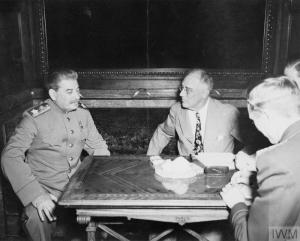
The initial reactions following the Yalta were positive, with the Americans viewing the conference as proof that the cooperation between the U.S and Soviet Union would continue post-war. However, these feelings were short lived. With the death of Roosevelt, and the subsequent election of Harry Truman as the new President, the relationship between the Soviet Union and the U.S began to shatter, with concern of the Soviet’s influence in Eastern Europe and the United Nations.[4] At the time, many began to criticise Roosevelt’s handling of the Yalta conference and even now there are some that accuse him of “handing over” Eastern Europe and North-east Asia to the Soviet Union, despite the fact that this was not the case.
In fact, considered the one definite agreement that occurred during the Yalta conference, and the only concession that Churchill and Roosevelt made, was within the discussion around the conditions under which the Soviet Union would consider entering the Pacific battlefields. It was decided that the Soviets would be granted influence over Manchuria, a region of north-eastern China, after the Japanese surrender, and in return would enter the Pacific theatre.[5] The Soviet Union had lost this territory in the 1904-5 was with Japan, and thus its return was considered by Churchill and Roosevelt a small sacrifice to make in order to secure Allied victory in the Pacific.[6]

It soon became clear that Stalin had no intention of keeping any of the agreements made by the Soviet Union at the Yalta conference. By the time the Potsdam Conference was in session (which you can read more about here), Stalin’s troops occupying much of Germany and Eastern Europe, thus leaving Stalin in a prime position to effectively ratify the concessions he was awarded at the Yalta conference, while simultaneously making U-turns on many of decisions he had agreed to.[7] By 1946, little more than a year after the Yalta conference was held, Churchill delivered his famous “iron curtain” speech, and thus the relationship formed between the Soviet Union and its Western allies during the Second World War crumbled, and the Cold War began…
[1] Office of the Historian, Foreign Service Institute, “The Yalta Conference, 1945,” United States Department of States, last accessed 1 May 2023, https://history.state.gov/milestones/1937-1945/yalta-conf
[2] Office of the Historian, Foreign Service Institute, “The Yalta Conference, 1945”
[3] Unknown author, “Yalta Conference,” History, last accessed 1 May 2023, https://www.history.com/topics/world-war-ii/yalta-conference
[4] Office of the Historian, Foreign Service Institute, “The Yalta Conference, 1945”
[5] Office of the Historian, Foreign Service Institute, “The Yalta Conference, 1945”
[6] Unknown author, “Yalta Conference”
[7] Unknown author, “Yalta Conference”
[Image 1] Imperial War Museum (IWM), The Yalta Conference February 1945, TR 2828, https://www.iwm.org.uk/collections/item/object/205125296
[Image 2] IWM, The Yalta Conference 1945, NAM 240, https://www.iwm.org.uk/collections/item/object/205200044
[Image 3] IWM, The Yalta Conference February 1945, NAM 229, https://www.iwm.org.uk/collections/item/object/205200041
 It’s all in the Past...