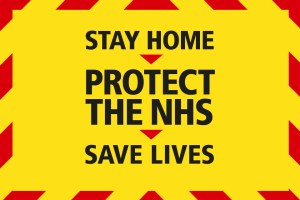
On 5th May 2023 the World Health Organisation announced that COVID-19 was no longer to be considered a global health emergency. Just over three years before, on 29th January 2020, the first two patients in the UK tested positive for Coronavirus, with the country entering its first national lockdown two months later. All ‘non-essential’ shops were closed, people were ordered to stay at home, and travel unless for essential purposes was prohibited.[1]
On 1st June 2020, three years to this day, the restrictions on leaving the home were replaced with the requirement to be home overnight, and people were allowed to meet outside again, albeit in groups of no more than six.[2] Over the next year Britain was continually faced with lockdowns, COVID restrictions and tiered systems until March 2021, when the country began its phased exit from its third and final lockdown.
This was not the first pandemic that Britain had ever faced. In fact, Britain has endured its fair share of country wide illnesses from as far back in history as is documented. Therefore, this blog will explore the country’s responses to the plagues that occurred across the early modern era.
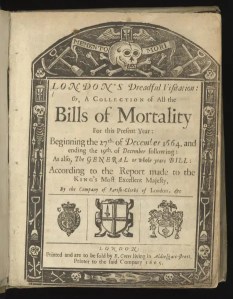
The first plague in London was recorded in 1348-9, and the last began in 1665, one of the biggest reoccurring epidemics known in English history.[3] The reason the plague was so deadly was because it spread quickly causing a high death toll, just like COVID-19. The London Bills of Mortality give historians the best insight into what was killing people in the latter part of this period and are useful when examining plague deaths.[4] The data was compiled into weekly lists on command of King Charles II and the information was sent from London across the country. However, some historians criticise the use of the Bills when studying mortality as there has been questions over their reliability, as although it would have been relatively easy to gain the information of baptisms and deaths, to find out what caused the death of a person was often a lot harder, as medical knowledge was very limited compared to today’s standards.[5]
Many people looked to the authorities of the country to find a solution. The authorities themselves also wanted to control and prevent the spread of the plague as it stunted population growth, had a massive impact on society, and greatly affected the economy. Across the early modern period various Books of Orders were produced concerning death, but the first one specifically on plague epidemics was printed on command of the Privy Council in 1578.[6] The idea of these books was to “impose policies which were not already part of the poor-law machine.”[7] They were published for everyone but directed mainly at the poor, as it was believed the plague was a disease of the poor.
But the Books of Orders were not the only plague documents produced by the authorities with the poor specifically in mind. Commissioned by the Lords of the Council, the “Physicall directions in time of plague” were published in 1644.[8] This document provided people with various ways to avoid catching the plague, as well as solutions and remedies if they began to display certain symptoms. It offered preventative methods for in houses, such as keeping one’s house “clean, free from filth” and to “open windows sometimes”. [9] The way the plague spread was unknown at this time, but they believed by keeping clean and airing out houses it would prevent people becoming susceptible to the disease.
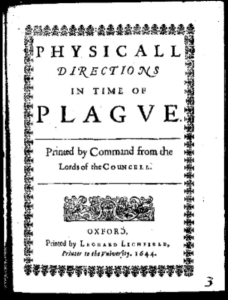
The directions also suggested preventative methods for individuals. The suggestions included “wearing cloaths perfumed with Juniper, red Sanders, or Rosemary” or carrying the mixture in a pouch, as it was believed wearing strong smelling mixtures would ward of unwanted, poisoned air.[10] The methods put forward by the Lords of the Council in “Physicall directions in time of plague” were completely ineffective. However, they would have given people hope, as coming from a higher authority would make the information seem reliable and trustworthy. Although both the Books of Orders and the directions were not written during the worst plagues, in 1563 and 1603, they would have been able to be applied across all of the future plague epidemics the country faced.[11]
One other measure that is well known in today’s Britain was quarantining. The idea of quarantining came from the continent as early as the fourteenth century.[12] Before quarantining began in England officially, it was ordered that infected houses were to be marked in order to be identified as infected.[13] Eventually this extended into full quarantining, with houses being locked “with all members of the family… sick or healthy, still inside them.”[14]
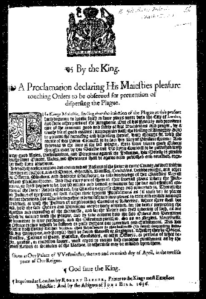
Justices of the Peace were to inform those lower than themselves, such as the “sheriffes, baliffes, constables… and subjects” to enforce this proclamation.[15] Not following the orders of this proclamation could get one into serious trouble. All the subjects of the king, included those with titles such as sherif or Justice of the Peace, could face “punishment as by the [?] Lawes or Statutes of the Realme”.[16] The monarch and his government took the task of preventing the plague seriously.
However, like other government measures, quarantining was an ineffective prevention of the plague. It was unknown in the early modern period that the plague spread through fleas and rats, so could spread from an infected house to a clear one without obvious detection. Quarantining would not have prevented this, and if anything, merely exacerbated the mortality rate as quarantining families, both sick and well, meant shutting them in with rats that likely carried the plague disease. It is clear, however, that the government and the monarch felt they had found an active solution, as at the time it was popular belief that the plague was transmitted as a miasma in the air.
The plague of 1665 caused at least 225,000 deaths in London and the parishes surrounding alone, as well as having a huge effect on mortality across the country.[17] Across the country the plagues before 1520 alone caused “the population in England to [drop to] around 2.4 million” half of which it had been at the beginning of the 1300s.[18] The plague caused an extremely high mortality rate in early modern Britain, and it was not until the 17th century that this would begin to fall, and the last major epidemic plague was recorded.
This blog was compiled by drawing together information from my undergraduate studies on the plague in Britain.
[1] Jennifer Brown, Esme Kirk-Wade, Carl Baker and Sarah Barber, “Coronavirus: A history of English lockdown laws,” House of Commons Library, published 22 December 2021, last accessed 13 May 2023, https://commonslibrary.parliament.uk/research-briefings/cbp-9068/#:~:text=First%20national%20lockdown%20(March%20to%20June%202020)&text=People%20were%20permitted%20to%20leave,of%20up%20to%20six%20people.
[2] Brown, Kirk-Wade, Baker and Barber, “Coronavirus: A history of English lockdown laws”
[3] Paul Slack, The Impact of Plague in Tudor and Stuart England (Oxford: Clarendon Press, 1990), 14
[4] The Company of Parish-Clerks of London, London’s dreadful visitation: or, a collection of all the Bills of Mortality for this present year: Beginning the 27th of December 1664 and ending the 19th of December following (London: E. Cotes living in Aldersgate Street, 1665) (accessed from the Wellcome Library)
[5] Peter Razzell, “The History of Infant, Child and Adult Mortality in London, 1550-1850,” London Journal 32, no. 3 (2007): 273
[6] Paul Slack, Poverty and Policy in Tudor and Stuart England (London: Longman, 1988), 139 & Paul Slack, The English Poor Law, 1531-1782 (Basingstoke: Macmillan, 1999), 22
[7] Slack, Poverty and Policy in Tudor and Stuart England, 143
[8] Leonard Lichfield, Physicall directions in time of plague (Oxford, 1644) (accessed from Historical Texts)
[9] Lichfield, Physicall directions in time of plague, 1
[10] Lichfield, Physicall directions in time of plague, 2
[11] Slack, Poverty and Policy in Tudor and Stuart England, 141
[12] Paul Slack, The Impact of Plague in Tudor and Stuart England, 45
[13] Paul Slack, Poverty and Policy in Tudor and Stuart England, 116
[14] Slack, Poverty and Policy in Tudor and Stuart England, 139
[15] Robert Barker, By the King. A proclamation declaring his maiesties pleasure touching Orders to be observed for prevention of dispersing the Plague (Imprinted in London, 1636) (accessed from Historical Texts)
[16] Barker, By the King
[17] Slack, The Impact of Plague in Tudor and Stuart England, 174
[18] Keith Wrightson, Earthly Necessities: Economic Lives in Early Modern Britain, 1470-1750 (London: Penguin, 2002), 99
[Image 1] Gov.uk Press Release, ‘New hard-hitting national TV ad urges the nation to stay at home,’ published 22 January 2020, last accessed 19 March 2021, https://www.gov.uk/government/news/new-hard-hitting-national-tv-ad-urges-the-nation-to-stay-at-home
[Image 2] The Company of Parish-Clerks of London, London’s dreadful visitation: or, a collection of all the Bills of Mortality for this present year: Beginning the 27th of December 1664 and ending the 19th of December following (London: E. Cotes living in Aldersgate Street, 1665) (accessed from the Wellcome Library)
[Image 3] Leonard Lichfield, Physicall directions in time of plague (Oxford, 1644) (accessed from Historical Texts)
[Image 4] Robert Barker, By the King. A proclamation declaring his maiesties pleasure touching Orders to be observed for prevention of dispersing the Plague (Imprinted in London, 1636) (accessed from Historical Texts)
 It’s all in the Past...