Under the Armistice terms of 1918, Germany was required to surrender all their U-boats and forbidden to build more. However, by 1935, with Hitler’s rejection of the Treaty of Versailles, Germany forcibly negotiated the right to build more U-boats. Thus, the German Navy was ready to renew their brutal U-boat campaign of the First World War for a second time, entering the war with 30 operational U-boats.[1]
Although a small number, insufficient to impose a blockade on Britain, during the first few weeks of the war alone the German U-boat campaign had huge success. Britain was not prepared for the revival of submarine warfare, which it believed had been stopped by the 1918 Treaty. What became known as the Battle of the Atlantic first began on 3 September 1939, when a shipping liner was sunk by a U-boat U-30.[2] Believed by some historians to be the ‘first phase’ of the German U-boat campaign, they often operated alone in the beginning stages of the war.
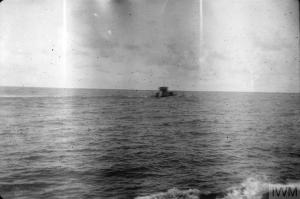
This ‘first phase’ ended around March 1941, when Allied merchant ships began sailing in convoy with trained escort groups of both ships and aircraft, to deter lone U-boat crews (see my previous blog on Q-Ships). This did little to deter the German U-boat campaign, however, with ‘phase two’ starting with the acquiring of air and U-boat bases in Norway and Western France.[3] These bases enabled U-boat crews to reach much father into the Atlantic.
At the same time, the U-boats also began operating in groups, known as wolf packs by the British.[4] One U-boat would shadow a convoy, summoning other crews ready to attack on the surface once night fell.[5] Until radar was invented, this tactic was highly successful, at great detriment to the Allied Navy. The hight of the German U-boat campaign came in March 1943, when the German crews very nearly succeeded in cutting of the British in the Atlantic. However, by May, British escort carriers and long-range bombers were available, halting the German U-boat advance in the Atlantic.
With the German U-boat crews changing tactic again, the ‘third phase’ began when the U-boats were sent to quite waters where unescorted targets could be found, such as in the Indian Ocean.[6] However, the Allied strategy of attacking U-boat supply vessels proved successful, forcing the U-boat campaign to enter its final phase.
‘Phase four’ saw the U-boats fitted with a snorkel tube, which allowed for an extended periods underwater and greatly reduced the likelihood of the attackers being picked up by Allied radar.[7] However, by this point in the war the U-boat campaign had suffered heavy losses and having returned to the coast around the British Isles, decided to pull back. The final casualty of the German U-boat campaign occurred on 7 May 1945, when U-2336 torpedoed two steamers in the North Sea.[8]
Across the Second World War, Germany built 1,162 U-boats, of which 785 were destroyed.[9] The remainder were either captured or fled to avoid surrender. Of the 632 U-boats that were sunk at sea, the Allied trained escorts accounts for the greatest majority of losses. The Battle of the Atlantic saw the struggle to develop new technologies to defeat the enemy on both sides.

[1] Stephen Gill, “The Battle of the Atlantic 1939-1945: Anti-Submarine Warfare,” p. 4, last accessed 2 February 2023, https://www.academia.edu/7926533/The_Battle_of_the_Atlantic_1939_1945_Anti_Submarine_Warfare
[2] Gill, “The Battle of the Atlantic 1939-1945,” p. 1
[3] Britannica, “U-boat – German submarine” last accessed 2 February 2023, https://www.britannica.com/technology/U-boat
[4] Gill, “The Battle of the Atlantic 1939-1945: Anti-Submarine Warfare,” p. 1
[5] Uboat.net, “The Wolfpacks – What is a Wolfpack,” last accessed 2 February 2023, https://uboat.net/ops/wolfpacks/overview.htm
[6] Britannica, “U-boat – German submarine”
[7] Britannica, “U-boat – German submarine”
[8] Gill, “The Battle of the Atlantic 1939-1945,” p. 1
[9] Britannica, “U-boat – German submarine”
[Image 1] Imperial War Museum, “Action of HM Trawler Lady Shirley with German U-boat. September 1941, on board HMT Lady Shirley, during and after the action” September 1941, A 5794, last accessed 2 February 2023, https://www.iwm.org.uk/collections/item/object/205140001
[Image 2] WikiCommons, “U-boat Production: Two Type XXI submarines ready for launching at Hamburg,” last accessed 2 February 2023, https://commons.wikimedia.org/wiki/File:U-boat_Warfare_1939-1945_CL2747.jpg


Interesting stuff Hannah, I had realized that there were four phases, thanks for the informative post, cheers Pat.
LikeLiked by 1 person